
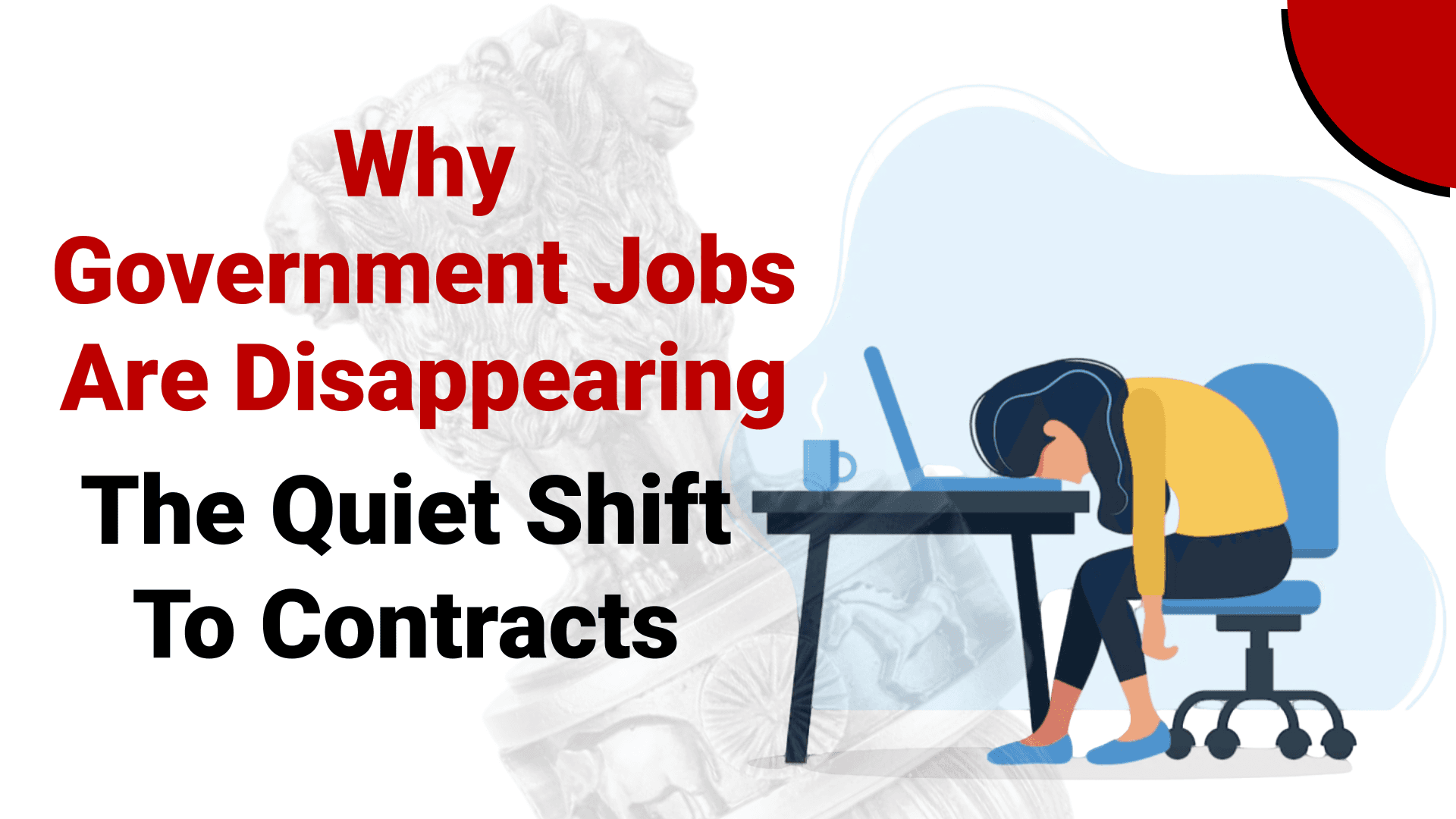
Once upon a time, a government job in India was the golden ticket — permanent, pensioned, prestigious. Parents proudly declared, “Mera beta sarkari naukri mein hai.” But fast forward to today, and there’s a silent shift happening across sectors. From the armed forces to classrooms, from hospitals to highways — permanent jobs are vanishing, replaced by contractual posts that come without security, benefits, or dignity.
The Disappearing Act: How the Sarkari Job is Being Rewritten
For decades, government employment meant lifelong service, job security, fixed promotions, and pensions.
But in the last 10 - 20 years - we’ve seen a noticeable transition:
- Fewer permanent job openings in public notifications
- More contract-based roles for the same work, same hours, but with lesser pay and no benefits
- Departments operating with 30%–50% vacancies, yet opting for temporary hiring
This isn’t just about hiring style. It’s a change in mindset — one that is reshaping how the public sector functions
Why the Shift?
1. Budget Control Over People’s Livelihoods
Governments want to cut costs. Permanent employees come with pensions, pay commissions, gratuity, and annual increments. Contract staff? None of that baggage.
A government department saves nearly 40–60% per head when they hire on a contract instead of a regular post.
2. Projectization of Public Work
From education to defense, government work is increasingly being treated like “projects” with start and end dates. And projects don’t need permanent staff — they need “human resources” on demand.
3. Private Sector Influence & Gig Economy Mindset
Just like Zomato hires delivery agents, governments now hire “outsourced staff” — whether its a teacher for a village school or a lab technician for a district hospital.
4. Skill-Based Hiring, Not Career-Based Planning
Instead of building long-term internal talent, governments now want short-term specialists — someone who can build a bridge or set up a vaccination drive and leave. No long-term integration. No loyalty.
Defense & Armed Forces
- Permanent commissioned officers are reducing.
- Agniveer scheme has turned soldier recruitment into a 4-year contract with no pension.
- Private security and training contractors are rising.
- Implication: Drop in morale, fewer applicants from traditional defense families.
Education
- Guest teachers, para-teachers, and ad-hoc faculty are the new norm — even in central universities and state boards.
- Contracts renewed annually, no long-term planning.
- Implication: High turnover, low quality, and disillusioned teaching staff.
Healthcare
- Staff nurses, lab techs, ambulance drivers — all increasingly outsourced.
- During COVID-19, many were hired temporarily, and later terminated masse.
- Implication: No continuity in public healthcare workforce.
Why Government Jobs Are Disappearing: The Quiet Shift to Contracts
From Stability to Struggle — The Human Cost of Sarkari Downsizing
Above, we discussed how and why permanent government jobs are vanishing, replaced by contract-based roles across key sectors like defense, education, and healthcare. Now, let’s look at what this means on the ground — not just for jobseekers, but for the quality of governance, public service, and the dream of a better life that these jobs once represented.
For job listings and further reading visit: rozgar.com.
Check government hiring updates & resources at: https://rozgar.com
What Happens When Permanent Jobs Disappear?
1. Brain Drain From the Public Sector
Smart, qualified youth — the kind who used to line up for UPSC, SSC, or state-level exams — are now thinking twice. Why study 3–5 years for a temporary job that offers:
- No pension
- No pay security
- No career progression
- No dignity in service
So what do they do? They switch to private jobs, overseas opportunities, or worse — stay unemployed in hope of a real job that may never come.
2. Erosion of Trust in the System
Contractual staff may change every year. A new teacher for your child every semester. A new nurse every month. A new road contractor for every patch.
People begin to lose faith in the government’s ability to:
- Deliver consistent services
- Build long-term programs
- Solve real problems with real people
This creates a sense of “chalta hai” — a dangerously casual culture that affects everything from healthcare to policing.
3. Unequal Pay for Equal Work
Two employees sitting in the same government office. Same role, same hours. One is permanent. The other is on contract.
- The permanent one gets ₹70,000/month, pension, DA, and annual hikes.
- The contractual one gets ₹18,000–25,000/month, no benefits, and fear of termination.
- How long can such inequality last before it becomes resentment?
4. Decline in Institutional Memory & Leadership
In any organization, long-serving staff carry not just experience but institutional memory — they know what worked, what failed, and why.
But with short-term contracts, there’s no continuity. Every new officer or worker starts from zero. This leads to:
- Repetition of mistakes
- Delays in decision-making
- Lack of mentorship and leaders
But Whos Benefiting From This Shift?
Let’s be clear: someone is winning in this contract raj.
- Private staffing firms supplying workers to government departments at a margin
- Politically linked contractors getting short-term service tenders
- Outsourcing agencies that profit from the lack of government recruitment
Meanwhile, the government can claim it is creating “jobs” — without adding anyone to the permanent rolls.
Contract-Based Governance Is Not a Temporary Phase
This isn’t just a short-term experiment. It’s a long-term trend being normalized through:
- New policies (like Agnipath for defense)
- Hiring freezes on permanent roles
- Deliberate delays in exams and appointments
- Outsourcing even sensitive work like census, Aadhaar enrollment, health surveys
The permanent job is not just dying — it’s being strategically phased out.
Why Government Jobs Are Disappearing: The Quiet Shift to Contracts (Part 3)
Governance on Lease: When Public Services Start Acting Like Private Startups
In Parts 1 and 2, we explored how permanent government jobs are being replaced with contracts — and how that shift is already eroding public trust, employee dignity, and service quality. But in Part 3, we face the bigger question:
What happens when governments themselves start functioning like private companies? Spoiler: The public pays the price.
Contractual Governance = Corporatized Public Service
In the name of efficiency, cost-saving, and “agility”, many departments now operate with a startup-like mindset:
- Project deadlines over long-term planning
- Metrics over mission
- Outsourcing over ownership
Sounds smart? Maybe in a tech company. But not when you are running a school, hospital, or national defense system.
What We’re Losing in the Process
1. Commitment & Accountability
Contractual workers come and go. They are rarely held accountable, and they have little stake in outcomes.
- A guest teacher won’t build the school.
- A 4-year Agniveer won’t stay to mentor the next generation.
- A temp nurse won’t take ownership of rural health data.
There’s no “service mentality” left — just tasks, checklists, and survival.
2. DIY Governance for Citizens
With no permanent staff in village offices, clinics, or land departments, citizens are increasingly expected to:
- Fill forms online
- Lodge complaints via portals
- Navigate helplines
- Handle middlemen
(The government has shrunk — and been replaced by a system that citizens must learn to operate.)
3. Public-Private Confusion
You don’t know who’s a government worker anymore.
- Is the person taking your blood test in a government hospital an actual government employee?
- Is the teacher at your local school hired by the education department — or an NGO under CSR funding?
- Is the helpline operator handling your ration card employed by the state — or a Noida-based vendor?
The Bigger Threat: Collapse of Aspirational India
Ask any student from a Tier-2 or Tier-3 town:
“Why are you preparing for SSC, UPSC, railway, banking, or police exams?”
They’ll say: "For stability. For respect. For family."
But what happens when even those dreams are downgraded to contracts?
- Suicides among aspirants rise due to uncertainty
- Youth drift to private jobs or gig work — often underpaid
- Rural families lose their one shot at economic mobility
A permanent government job was never just about income. It was social insurance, community pride, and inter-generational upliftment.
Is There Hope? Can This Be Reversed?
Yes — but only if there is public pressure and policy correction.
What Needs to Change:
- Mandated ratio of permanent to contract workers in every department
- Strict caps on outsourcing critical public functions
- Time-bound recruitment calendars for permanent jobs
- Restoration of pay parity for equal work
- Creation of a Public Service Charter with job dignity at its core
What Citizens Can Demand:
- Stop election promises of “jobs” that turn out to be internships or temp roles
- Transparency in contractual hiring, including pay and tenure
- Reopening of lapsed posts that have remained vacant for years
Because Governance Is Not a Gig Job
A country can’t be built by temporary people doing permanent work.
We need committed officers, teachers, doctors, engineers, and police — not just for 11 months, but for 30 years of service and sacrifice.
The contract model works for pizza delivery.
It does not work for public good.
State-Wise Pattern: A National Epidemic
State | Sector Hit Hardest | Scale of Contractualization | Protest Movements |
|---|---|---|---|
Punjab | Education | 75% of teachers on contract | Strong, ongoing |
Uttar Pradesh | Health & Panchayat | Over 3 lakh on honorarium | ASHA strikes, protests |
Delhi | MCD, Transport, Health | 60% outsourced | Sanitation strikes |
Bihar | Railways, Defense (Agnipath) | Youth-based mobilization | Large-scale protests |
Himachal | JBT, PAT Teachers | 50% still temporary | Peaceful dharnas |
Maharashtra | Contract Doctors/Nurses | 2-year rolling contracts | Minimal, suppressed |
Telangana | Village Revenue Assistants | No pay parity, no pension | Online campaigns |
Why Protests Are Failing to Create Real Reform
- Media fatigue: These issues rarely make national headlines beyond protests.
- Divide-and-rule tactics: Government treats each group as isolated — guest teachers, ASHAs, MTS, etc. — not as part of a larger structural crisis.
- Fear of unemployment: Most contractual workers don’t protest, fearing dismissal.
- Public apathy: Middle-class voters believe “at least they have a job”, ignoring how governance quality is degrading.
The Growing Demand: Regularize or Radicalize
- EqualWorkEqualPaycampaigns on social media
- Unified protests by allied services (teachers + nurses + clerks)
- Court cases demanding backpay, benefits, and regularization
- Petitions pushing for a National Contract Workers Commission
But the biggest demand is simple:
Stop running the government like a staffing agency.
Register now on Rozgar.com
| Latest Category Jobs | ||
|---|---|---|
| Job Information | Apply Job | |
Dell Boomi Developer(4-7 years) | ||
Senior Software Engineer-Frontend(3-5 years) | ||
TP Senior Advisor(2-4 years) | ||
Performance Testing(3-8 years) | ||
Java Developer – AWS(8-10 years) | ||
Hiring Fresher Graduates(0-1 years) | ||
Create Your Free Job Alert
Related Posts
View All
HPPSC Police Constable Recru...
HPPSC Police Constable Recruitment 2026 – 734 पदों पर भर्ती | पात्रता, शारीरिक मानक, दस्तावेज और Online Apply की पूरी जानकारी
हिमाचल प्रदेश में सरकारी नौकरी की तलाश करने वाले युवाओं के लिए 2026 में एक बेहतरीन मौका आया...
read more Ayush Yadav 20 Jul, 2026
NFR Act Apprentice Recruitme...
NFR Act Apprentice Recruitment 2026 – 6777 पदों के लिए ऑनलाइन आवेदन, पात्रता, ट्रेड लिस्ट और पूरी जानकारी
अगर आपने ITI पूरी कर ली है और रेलवे में अपना करियर बनाना चाहते हैं, तो 2026 में आपके लिए एक बड़ा और ऐतिहासिक मौ...
read more Ayush Yadav 16 Jul, 2026
Union Bank Apprentice 2026, ...
Union Bank Apprentice 2026, SBI Resolvers & Punjab Sind Bank SO – Apply Online in May 2026 for 1997 Bank Posts
May 2026 is turning out to be one of the most active months for banking job seekers in India. Three major ...
read more Ayush Yadav 14 Jul, 2026