
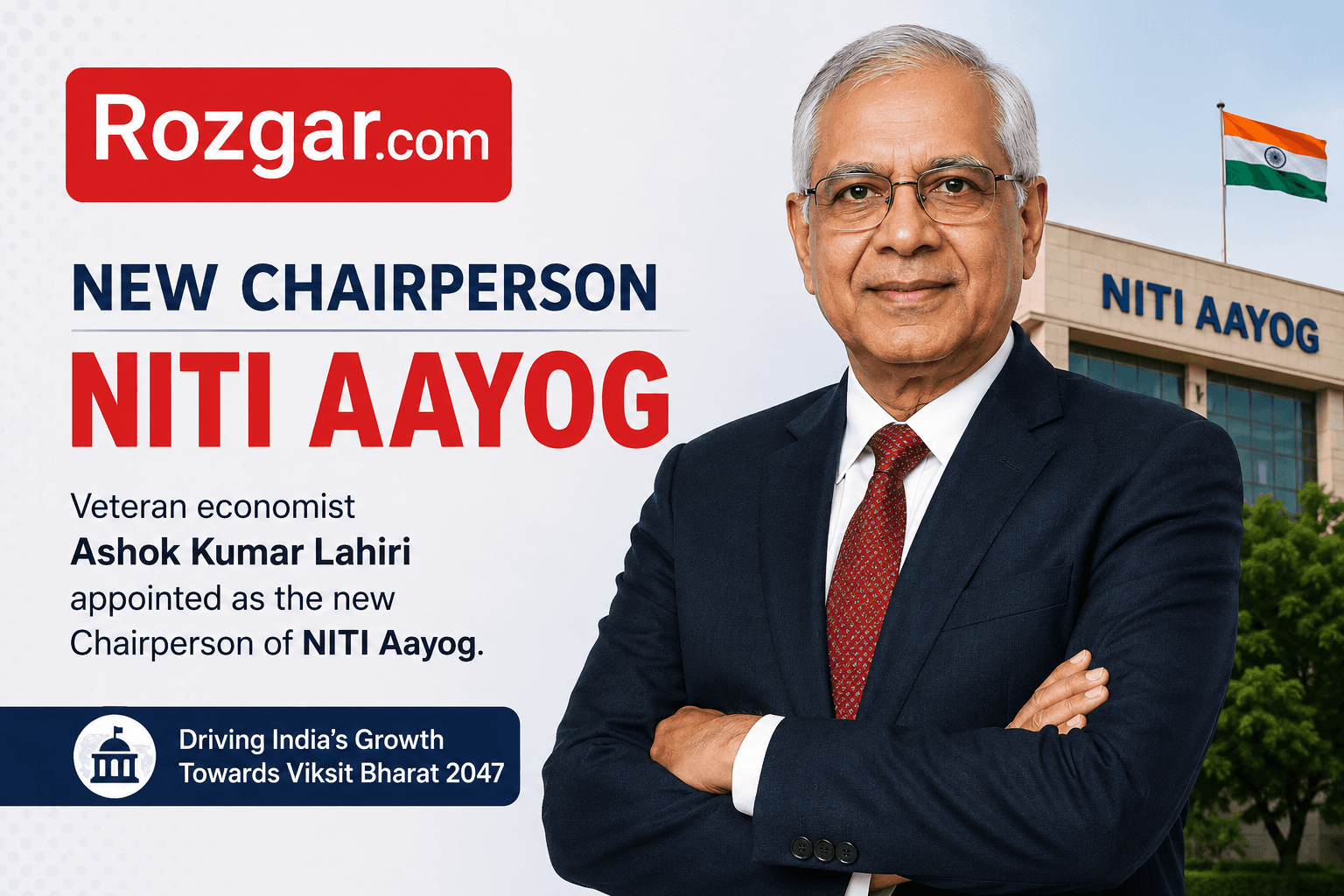
Appointing Ashok Kumar Lahiri as Vice-Chairperson of NITI Aayog:
Appointing Ashok Kumar Lahiri as Vice-Chairperson of NITI Aayog:
Indias premier policy think tank, NITI Aayog, has a new face at the helm. The Government of India recently reconstituted the Aayog and appointed veteran economist Ashok Kumar Lahiri as Vice-Chairperson of NITI Aayog, placing him as the second-highest authority in the institution after Prime Minister Narendra Modi, who serves as its Chairperson.
This is not just a routine reshuffle. Lahiri brings over four decades of experience in economic policy — from advising the Finance Ministry as Chief Economic Adviser to working with global institutions like the IMF, World Bank, and the Asian Development Bank. If you want to understand what this appointment means, who Ashok Kumar Lahiri really is, and why his arrival at Neeti Aayog matters to ordinary Indians, this article is your complete guide.
Who Is Ashok Kumar Lahiri? A Career Spanning Four Decades
Before understanding the significance ofappointing Ashok Kumar Lahiri as Vice-Chairperson, it helps to know the man behind the title.
Lahiri is a seasoned economist who began his academic journey at Presidency University in Kolkata and later studied at the Delhi School of Economics — two of Indias most respected institutions for economics. His career has been defined by a rare combination of academic depth and real-world policy experience.
Key Roles Held by Ashok Kumar Lahiri
- Chief Economic Adviser (CEA), Government of India (2002–2007): In this role, he advised the Finance Ministry on macroeconomic policy, taxation, fiscal management, and economic reforms. He served under two Prime Ministers — Atal Bihari Vajpayee and Manmohan Singh — a testament to the non-partisan respect he commanded.
- Director, National Institute of Public Finance and Policy (1998–2002)
- Member, 15th Finance Commission:He played a direct role in shaping how tax revenues are shared between the Centre and the states.
- Executive Director, Asian Development Bank (ADB)
- Senior Economist, International Monetary Fund (IMF
- Consultant, World Bank
- Chairman, Bandhan Bank
- MLA, West Bengal Legislative Assembly (Balurghat constituency, BJP)
This combination of domestic and international policy experience, along with his legislative exposure in West Bengal, makes Lahiri an unusually well-rounded figure for the role.
What Is NITI Aayog and Why Does the Vice-Chairperson Matter?
For those new to the term,NITI Aayog (National Institution for Transforming India) was established in January 2015 to replace the old Planning Commission. Where the Planning Commission worked in a top-down model, NITI Aayog was designed to be a collaborative think tank that works with state governments rather than imposing decisions on them.
The Aayog focuses on:
- Cooperative federalism— keeping states as equal partners in development
- Long-term development planningaligned with Indias national goals
- Policy research and innovationto find practical solutions to complex problems
- Monitoring and evaluatinggovernment schemes and programs
So, What Does the Vice-Chairperson Actually Do?
The Prime Minister serves as the Chairperson of NITI Aayog, but given his responsibilities as head of government, theVice-Chairperson is the effective operational head. This person leads the day-to-day functioning of the Aayog, coordinates with ministries, engages with state governments, and represents the institution publicly.
In short, the Vice-Chairperson is the chief policymaker steering Indias long-term economic vision. This is whyappointing Ashok Kumar Lahiri as Vice-Chairperson of NITI Aayogcarries significant weight for Indias policy direction in the coming years.
Why Was Ashok Lahiri Appointed? Timing and Context
The government reconstituted NITI Aayog in April 2026, with Lahiri formally taking charge onMay 8, 2026. He succeededSuman K. Bery, the outgoing Vice-Chairperson.
The appointment comes at a critical juncture. India is navigating a complex global economic environment — rising trade uncertainties, geopolitical tensions affecting supply chains, and the challenge of sustaining domestic growth while keeping inflation in check. At the same time, the government is focused on its ambitious Viksit Bharat 2047vision — making India a developed nation by its centenary of independence.
Prime Minister Modi, on meeting Lahiri after the appointment, expressed confidence that his rich experience in economics and public policy would "greatly strengthen Indias reform journey" toward becoming a Viksit Bharat. Lahiri himself acknowledged that achieving this vision requires "well-framed and effective policies."
The reconstitution also brought in five new full-time members —Rajiv Gauba, Prof. K. V. Raju, Prof. Gobardhan Das, Dr. M. Srinivas, and Prof. Abhay Karandikar— signaling a broader refresh of the institutions leadership.
What Ashok Lahiris Appointment Means for Indias Economy
The choice of Ashok Kumar Lahiri as the new head of Neeti Aayog is more than symbolic. Heres what it signals about the governments policy priorities going forward:
1. Fiscal Discipline and Prudent Economic Management
Lahiris background as Chief Economic Adviser is deeply rooted in fiscal policy and budgetary management. His tenure as CEA saw India navigate significant economic challenges, and his instinct for keeping public finances sound is expected to influence how NITI Aayog advises on expenditure priorities.
2. Focus on Employment and Growth
As Vice-Chairperson, Lahiri is expected to guide policy in areas such asinvestment promotion, infrastructure development, and employment generation— all critical pillars of the Viksit Bharat agenda. For Indian citizens — including young job-seekers across states like Uttar Pradesh and the rest of the country — this focus on employment policy could have a very real impact. If youre looking for government job opportunities or updates on employment schemes, platforms like rojgar.com can keep you informed on the latest openings and vacancies.
3. Global Credibility for Indias Policy Framework
Having worked with the IMF, World Bank, and ADB, Lahiri understands how global financial institutions assess emerging economies. His presence at the top of NITI Aayog is likely to boost Indias credibility in international economic dialogues.
4. Bridging the Centre-State Divide
With his experience on the 15th Finance Commission — which directly deals with Centre-state financial relations — Lahiri is well-positioned to deepen NITI Aayogs cooperative federalism mandate, ensuring that states are genuine partners in national development rather than passive recipients of central directives.
NITI Aayogs Role in Indias Viksit Bharat Vision
One cannot talk about Ashok Kumar Lahiris appointment as Vice-Chairperson without understanding the larger vision he has been brought in to serve.Viksit Bharat 2047is the governments mission to transform India into a fully developed economy over the next two decades.
NITI Aayog sits at the center of this mission. It is tasked with:
- Identifying high-growth sectors that can create jobs and attract investmet
- Recommending structural reforms in education, healthcare, and infrastructure
- Working with states to ensure no region is left behind
- Tracking progress on key development indicators
Lahiris appointment is a signal that the government wants a steady, experienced hand to drive this agenda — someone who has seen economic policy from the inside for over four decades.
Previous Vice-Chairpersons of NITI Aayog: A Brief Look
Ashok Lahiri is the latest in a line of distinguished economists who have led NITI Aayog since its inception:
Vice-Chairperson | Period |
|---|---|
Arvind Panagariya | 2015–2017 |
Rajiv Kumar | 2017–2022 |
Suman K. Bery | 2022–2026 |
Ashok Kumar Lahiri | 2026–Present |
Conclusion
Each leader has brought a distinct style and area of emphasis. Panagariya focused on broad economic reforms; Rajiv Kumar championed innovation and startup ecosystems; Suman Bery worked extensively on climate and sustainability. Lahiris focus is expected to center on fiscal prudence, growth acceleration, and employment — themes central to Indias current development needs.
Frequently Asked Questions
Create Your Free Job Alert
Related Posts
View All
HPPSC Police Constable Recru...
HPPSC Police Constable Recruitment 2026 – 734 पदों पर भर्ती | पात्रता, शारीरिक मानक, दस्तावेज और Online Apply की पूरी जानकारी
हिमाचल प्रदेश में सरकारी नौकरी की तलाश करने वाले युवाओं के लिए 2026 में एक बेहतरीन मौका आया...
read more Ayush Yadav 20 Jul, 2026
NFR Act Apprentice Recruitme...
NFR Act Apprentice Recruitment 2026 – 6777 पदों के लिए ऑनलाइन आवेदन, पात्रता, ट्रेड लिस्ट और पूरी जानकारी
अगर आपने ITI पूरी कर ली है और रेलवे में अपना करियर बनाना चाहते हैं, तो 2026 में आपके लिए एक बड़ा और ऐतिहासिक मौ...
read more Ayush Yadav 16 Jul, 2026
Union Bank Apprentice 2026, ...
Union Bank Apprentice 2026, SBI Resolvers & Punjab Sind Bank SO – Apply Online in May 2026 for 1997 Bank Posts
May 2026 is turning out to be one of the most active months for banking job seekers in India. Three major ...
read more Ayush Yadav 14 Jul, 2026