
As the electrical industry gets closer to the year 2024, it is undergoing the ever-intensified evolvement, which is fired up by constantly improved technology and popular demand for sustainable energy solutions. This diverse career environment provides a pool of career option in Electricals for enthusiastic beginners and skilled professionals. Whether its to historical functions or digital depths. Jobs in the electrical sector offer specialized career options options for those who are dazzled by all that electricity can do.
Here, in this informative article, we are going to discuss What Are the Career Options in Electricals in 2024 (Top 10) which are known by the responsibilities, skills needed, and their description of salary ranges. Regardless of whether you’re just about to enter the industry as a fresher or are contemplating changing your job to electrology which offers new horizons, you will find this guide useful.
Top 10 Career Options In Electricals In 2024
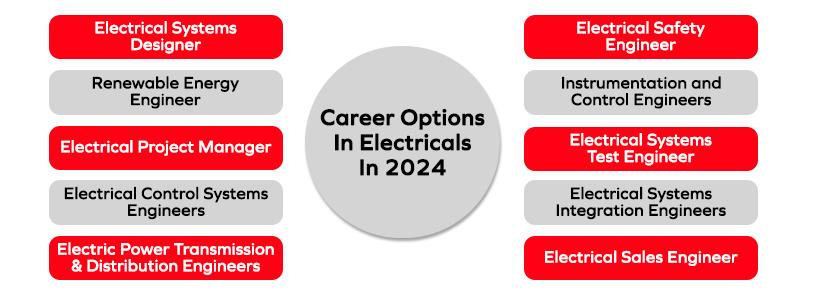
Here is the list of the top 10 Career Options in Electricals in 2024:
1. Electrical Systems Designer
In today’s modern world, the position of an electrical systems designer is of great importance. As the buildings and infrastructure are getting more and more complex, it is up to the designers to ensure that the electrical systems are functioning at top performance and at the same time they are environmentally friendly. They are to be in charge of producing designs for power distribution networks, lighting systems, and control systems among others adhering to safety laws and energy standards. They involve themselves with architects, engineers, and contractors so that they can come up with custom plans for the electric system design including the factors that are very specific for a particular project. Given the diverse ideas and the great focus on energy efficiency and sustainability, electrical systems designers need to be informed about the latest technologies and new industry trends.
Skills: While proficiency in CAD software, understanding of electrical codes and standards, strong problem-solving abilities, accuracy, and effective communication are some of the key requirements, workers need to develop those competencies over time. Potential Salary Package: Rs 6.5 lakh - 9.5 lakh per annum.
2. Renewable Energy Engineer
Being an era when greenhouse gases are emitted while technologies are pretty developed, renewable energy engineers are considered to be the driving force that alleviates sustainable energy challenges. Their primary function is mainly to design, construct, and put into use distributed renewable power systems including solar, piping, or water systems. They analyze the present systems, find the areas of improvement, and alter them to direct them into the systems that are more efficient with less environmental impact. On the side of the renewable energy engineers, there is the equally crucial task of conducting the feasibility study, performing the site assessment, and coordinating with stakeholders and project managers to ensure the effectiveness of the implementation of the renewable energy projects.
Skills: Knowledge of Renewable energy technologies, competency in simulation software, sharp analytical and logistic thinking, knowing how to comply with environmental rules and legislations. Potential Salary Package: Rs.7 LPA - Rs.11 LPA.
3. Electrical Project Manager
As one of the bosses responsible for managing electrical projects from the planning stage to final implementation, a project manager must ensure that every milestone is properly met until the success of the project is achieved. Their functions not only include but also define these domains as strategic planning, budgeting, scheduling, and managing resources such as personnel, materials, and equipment. They make sure that the projects have the time estimated, the budget plan, and the quality measurement while resolving the challenges and hazards as well so they can control them. The appropriate communication and cooperation of all stakeholders such as contractors, team members, and the project are the bedrock for the good execution of the project. While supervising electrical projects, professionals often rely on their detailed knowledge of the electrical systems, codes, and regulations, to complete complex projects.
Skills: Excellent technical and human leadership skills are a must; management of projects, codes of electrical standards, risk management, and problem-solving capabilities altogether are requisite. Potential Salary Package: Ranging from Rs. 7.5 to Rs.12 LPA.
4. Electrical Control Systems Engineers
Of the many occupations that have emerged with the advent of automation and the Industrial Revolution, electrical control systems engineers are at the top of the list. Among their responsibilities is the design and building of control systems that service power industrial automation applications, robotics as well as power generation among other such functions. They are accountable for coding, debugging, and de-bugging these area control systems to remain functional at a high efficacy, efficiency, and reliability level. Getting together with electrical controls systems engineers other engineers, technicians, and operators is the key factor on the way to the understanding of the specific requirements and smooth integration of the controls systems into the overall system architecture.
Skills: Skills in programming languages (e.g. C++, Python) along with control theory experience, analytical and problem-solving skills as well as acquaintance with industrial automation standards and protocols. Potential Salary Package: Rs.7 - Rs.10.5 LPA is the range.
5. Electric Power Transmission and Distribution Engineers
With the demand for power growing steadily, electric power transmission and distribution engineers have crucial tasks of meeting the needs of customers while keeping the system reliable and efficient. On the other hand, their responsibilities include the planning, designing, supervision, and maintenance of overhead lines, underground cables, and substations. They prevent such shortcomings as power fluctuations, grid stability, and load follow-up, and they try to improve efficiency and reliability of the power grid. These engineers have to deal with both utility companies and governmental agencies as well as stakeholders in order to follow all the laws and standards existing in the field.
Skills: The power system fundamentals and expertise in the important simulation software, analytical and trouble shooting skills, knowledge of power grid rules and standards. Potential Salary Package: Rs.7.5 - Rs.11.5 LPA.
6. Electrical Safety Engineer
The issue of high voltage is of considerable importance when it comes to any industry where electric systems and equipment are in use. Electrical safety engineers form the vanguard of ensuring the safe application and serviceability of these components and machines. They perform risk assessment, conduct safety protocol development, and give hands-on safety trainings to crews on safe electrical practices. Initiating risk assessments, taking preventive steps, and investigating incidents to determine the causes and the launch of corrective actions form the basis of their role. An electro-safety engineer interacts and communicates with other professionals like engineers, technicians, and stakeholders to promote a safety culture and ensure adherence to the existing codes and regulations.
Skills: Understanding of electrical safety codes and particularities, good at analysis and communication, competency in identifying and solving hazardous situations, as well as skillful in safety training delivery techniques. Potential Salary Package: This Rs. 6.5 LPA to Rs. 9.5 LPA range.
7. Instrumentation and Control Engineers
In the manufacturing, as well as the processing sectors, instrumentation and control engineers, contribute positively to the industries by providing efficient control and operation of systems. They have to carry out the functions related to designing, developing, and operating systems for controlling and instrumentation in cases of process industries such as manufacturing, power generation, and petrochemicals. The plant personnel pick proper sensors, set parameters for system control, and maximize processes effectiveness in the corresponding conditions. Instrumentation & control engineers frequently collaborate with process engineers, operators, and maintenance workers to provide a fail-safe system with error troubleshooting capabilities.
Skills: Proficiency in languages for programming such as (e.g., LabVIEW, SCADA) skill in control theory, logical thinking, analytical approach, and knowledge of industry automation standards and protocols. Potential Salary Package: RS.7 - RS.11 lakh per annum.
8. Electrical Systems Test Engineer
The two main characteristics of this production process are the quality system and reliability. Electrical systems test engineers are responsible for developing and implementing precise test plans to make certain that a system or a component correctly operates and shows efficiency. They go over test results, then reveal the problems or defects and recommend solutions that enhance the system operation to conform with the specifications set. These engineers collaborate with design teams, project managers, and other stakeholders to create and adopt comprehensive test methods on products at every stage of the product development process.
Skills: Understanding of testing practices, ability to use testing software, great skill in analysis and problem-solving, prior experience in industry standards and testing rules. Potential Salary Package: Rs.6.5 Lac- Rs.10LPA.
9. Electrical Systems Integration Engineers
These days, when almost all interconnected devices are electrical systems integration engineers who play a vital part in the well-integrated systems and components that work well as a whole. The key part of their duties is to ensure the compatibility of different systems, as well as to make them work in harmony and find solutions in case of any integration problems. These professionals work in close collaboration with designers, project managers, and other stakeholders to state information needs and work on optimum integration solutions. They should be adept in advanced electrical systems, programming, and simulation software to ensure that a perfect installation is achieved and excellent system performance.
Skills: Educated about electrical systems, database of programming, and simulation software, such as analytical thinking and communication ability as well, as familiarity with integration protocols and standards. Potential Salary Package: Rs.3 - Rs.5 LPA.
10. Electrical Sales Engineer
Electrical sales engineers are representatives of electrical product manufacturers, the connection between them and customers. Essentially, they are clerks whose main task is to advertise and sell electrical gadgets while ensuring all complaints and product issues are resolved. They are involved carefully in sales team activities, product management, and customer service to get the complete picture of their precise needs and requirements. Electrical sales engineers ought to be fully aware of the products they are selling and be good listeners as well as communicators to represent customers in a way that they can understand and take advantage of product features, benefits, and technical specifications.
Skills: The candidate should have a high level of technical knowledge of electrical products, must have outstanding communication and interpersonal skills, have to fully understand customer needs, and know the sales strategies and techniques. Potential Salary Package: Rs,6.5 - Rs.10 LPA (base salary + commission).
Conclusion
By 2024, one can envision a wide career option in electricals that is capable of attracting just as many people with as many different skill sets. From energy-efficient designs to renewable sources developments, the scope is wide to reach the highest point. Technology inevitably continues to develop, and more roles and new areas of specialization emerge, which makes the crisis in informatics a thrilling period to begin a career in this dynamic sphere. No matter which field, power transmission, control systems, or electrical safety, you select, you can grow and excel just by getting involved. If you are looking for a convenient one-stop-shop that would support you in the process of choosing a suitable career path then Rozgar.com, a reliable platform that specializes in linking job seekers to gratifying prospects, may be the right choice for you.
Visit our website for more exciting articles!
Frequently Asked Questions
Some of the hottest job prospects in electricals by 2024 are environmental engineers, control systems engineers in electricity, power transmission and distribution engineers, and engineers of integration of systems in electricity. These tasks, due to the ever-growing importance of renewable energy, automation, and the network of electrical systems widgets, are backing their growth.
It requires individuals to have solid technical knowledge of electrical systems along with programming languages and simulation software aptitude, analytical and problem-solving abilities come in handy when dealing with real industrial issues whereas familiarity with industry standards and regulations is crucial. Good communication and project management skills are the foundation of a successful career in electrical. Besides, knowledge of the newest styles and technologies that exist in this field matters a lot, too.
In India, the desired salary for electrical engineering roles can be impacted by factors including the type of job, the sector, location, and due to individual expertise level. The authors also wrote that the remuneration may vary between ₹6.5 lakhs per annum and ₹12 lakhs per annum for posts like electrical systems designs, renewable energy engineers, project managers, and control system engineers.
Absolutely! Within the electricity industry, opportunities abound for vertical mobility and career aspiration. Working their way up from entry to intermediate positions, professionals can also build up fine technical skills to become project leaders, technical leads, or senior engineers in due course. Concurrently, searching for higher education or certifications can lead to the opportunity to be upgraded to superior functions or to any subspecialties offered by that field.
Create Your Free Job Alert
Related Posts
View All
Banking & Finance Jobs 2026 ...
Jobs 2026 – RBI, SBI, PNB, Union Bank और Central Bank में बड़ी भर्तियाँ
RBI, SBI, PNB, Union Bank of IndiaऔरCentral Bank of India— इन पाँचों में मिलाकर हज़ारों पद खाली हैं। Assistant General Manager से लेक...
read more Ayush Yadav 04 Jun, 2026
हरियाणा सरकार का बड़ा फैसला:...
हरियाणा सरकार ने युवाओं के भविष्य को मजबूत करने की दिशा में एक बड़ा और अहम फैसला लिया है। राज्य कैबिनेट ने पूर्व अग्निवीरों (Ex-Agniveers) को सरकारी नौकरियों में आरक्षण देने का ऐलान किया है। यह फैसला न केवल अग्निवीर योजना के तहत सेवा दे चुके युवाओ...
read more Yogesh Singh 10 Apr, 2026राजस्थान में नौकरियों की बहा...
राजस्थान में सरकारी नौकरी की तैयारी कर रहे युवाओं के लिए साल 2026 बेहद खास साबित हो रहा है। राज्य सरकार ने बड़े स्तर पर भर्तियों का ऐलान किया है, जिससे लाखों उम्मीदवारों को रोजगार के नए अवसर मिलने वाले हैं।
क्या है लेटेस्ट जॉब अपडेट...
read more Yogesh Singh 08 Apr, 2026