
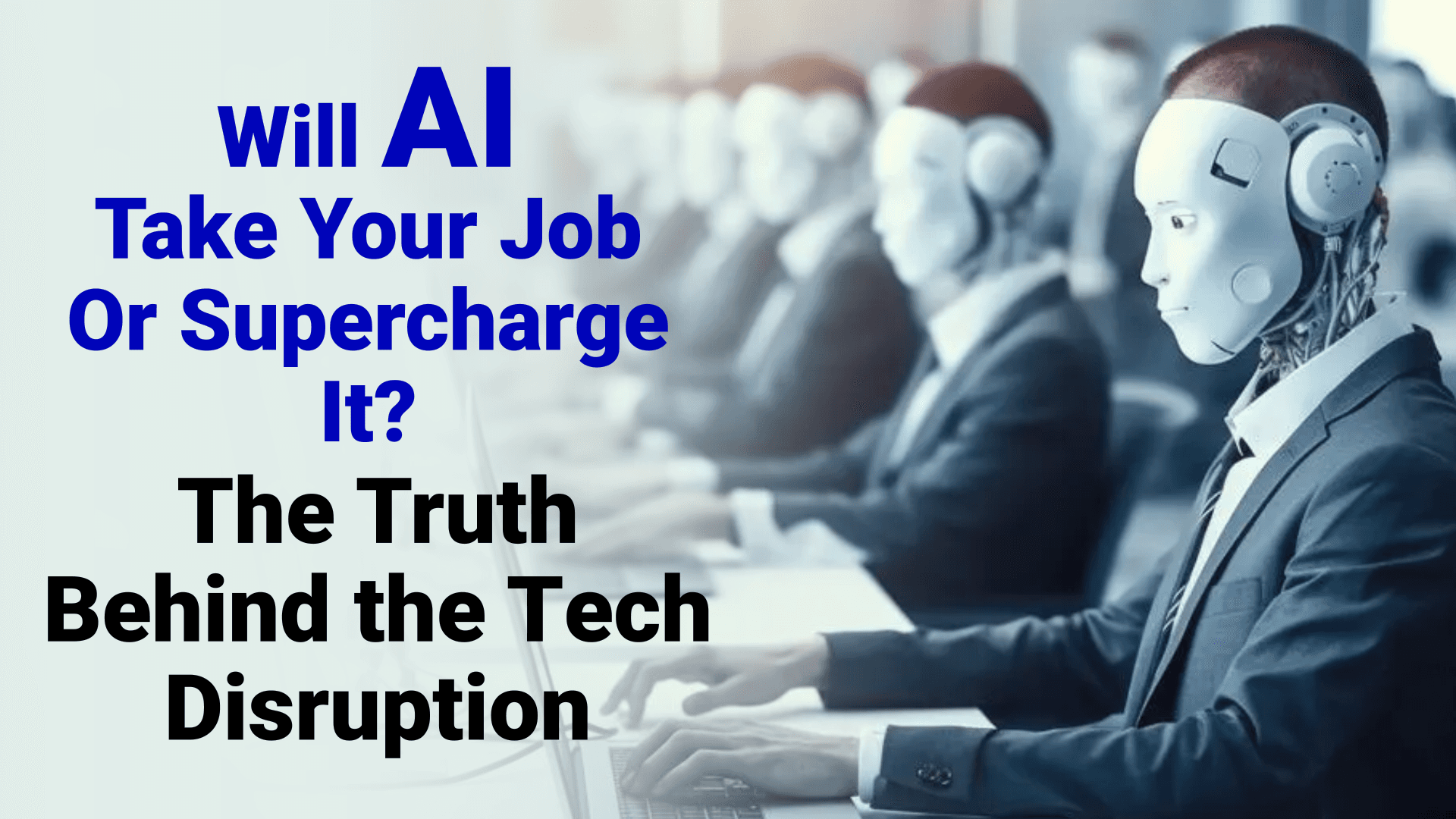
Artificial Intelligence isn’t coming for your job. It’s already here — and it’s rewriting the rules of work. From boardrooms to back offices, AI is reshaping how we produce, communicate, and compete.
But the real question isn’t whether AI will replace you. It’s whether you’ll evolve fast enough to stay ahead.
Welcome to the age of cognitive automation — where machines don’t just lift, sort, or calculate. They think. And that changes everything.
Tip: Focus on complementary skills — creativity, judgment, and systems thinking — to stay relevant.
The Rise of AI: Disruption or Opportunity?
According to McKinsey, 72% of companies globally now use AI in at least one business function. In manufacturing, healthcare, education, and logistics, AI is optimizing workflows, predicting outcomes, and personalizing experiences.
Generative AI tools like ChatGPT and Copilot have doubled their presence in marketing and sales since 2024.
But with this surge comes anxiety. The International Monetary Fund estimates that AI could impact 40% of jobs worldwide. That’s not just factory workers — it’s analysts, marketers, teachers, and even coders.
The question isn’t whether AI will disrupt, but how individuals and organizations adapt to turn disruption into opportunity.
What Jobs Are at Risk — And Why?
AI doesn’t eliminate jobs wholesale. It automates tasks — especially those that are repetitive, rule-based, and data-driven.
| Job Type | Risk Level | Why Its Vulnerable |
|---|---|---|
| Data Entry | High | Easily automated by LLMs and bots |
| Tier-1 Customer Support | High | Scripted interactions fit AI perfectly |
| Basic Content Creation | High | Generative AI can produce templated copy |
| Junior Coding | Medium | AI handles boilerplate and testing |
| Healthcare Diagnostics | Low | AI assists, but human judgment still leads |
| Strategic Marketing | Low | Creativity and brand nuance remain human |
The takeaway? If your job is mostly repeatable, it’s replaceable. But if it’s relational, strategic, or creative — AI becomes your co-pilot, not your competitor.
The Jobs AI Is Creating
It’s not all doom and displacement. AI is also creating millions of new roles — many of which didn’t exist five years ago:
- AI Specialists & ML Engineers
- Prompt Engineers
- AI Ethics Officers
- Hybrid Roles (e.g., AI-savvy marketers, healthcare analysts)
According to the World Economic Forum, 92 million jobs may be displaced by 2030, but 170 million new ones could be created. The net effect? A reshaped workforce — not a reduced one.
Skills That Will Keep You Relevant
To thrive in an AI-powered workplace, you need more than technical know-how. You need adaptive intelligence — the ability to learn, pivot, and lead.
Skills That Will Keep You Relevant
To thrive in an AI-powered workplace, you need more than technical know-how. You need adaptive intelligence — the ability to learn, pivot, and lead.
Must-Have Skills in 2025
- AI Literacy: Understand how models work, fail, and improve.
- Prompt Engineering: Craft inputs that yield useful outputs.
- Data Fluency: Know how to clean, interpret, and apply data.
- Tool Integration: Use AI within your existing workflows.
- Human Differentiators: Judgment, empathy, storytelling, negotiation.
In short: AI handles the “how.” You own the “why.”
How to Future-Proof Your Career
Here’s a 5-step roadmap to stay ahead of the curve:
- Audit Your Tasks: Identify what’s automatable vs. augmentable.
- Experiment with AI Tools: Use them to eliminate grunt work.
- Upskill Strategically: Focus on data, ethics, and creative thinking.
- Rebundle Your Role: Shift toward higher-value, judgment-based tasks.
- Teach Others: Share your learnings and become an internal AI champion.
What Employers Must Do
Companies can’t just deploy AI and hope for the best. They must redesign work around human strengths.
- Reskill the Workforce: Invest in training, not just tools.
- Redefine Metrics: Measure outcomes, not hours.
- Create Hybrid Roles: Blend domain expertise with AI fluency.
- Ensure Governance: Build policies around data, privacy, and oversight.
The smartest organizations won’t just automate — they’ll elevate.
The Bigger Picture: A New Social Contract
Governments and institutions must rethink education, labor laws, and safety nets. Portable credentials, apprenticeship models, and lifelong learning will be key to keeping workers attached to opportunity.
AI isn’t just a tech shift. It’s a societal one.
| Latest Category Jobs | ||
|---|---|---|
| Job Information | Apply Job | |
Specialist I - Software Engineering(9-11 years) | ||
Ecommerce Manager(5-7 years) | ||
Workday HCM/HRIS Consultant(12-15 years) | ||
Java Developer(8-10 years) | ||
Storage and Backup-Dell EMC, Nasuni Cloud Storage, NetApp, Brocade, CISCO,Cohesity(3-15 years) | ||
Lead Salesforce Developer(10-20 years) | ||
Conclusion
AI won’t take your job. But someone who knows how to use it might.
The future belongs to those who adapt, upskill, and lead. Whether you’re a fresher or a seasoned professional, your next move should be strategic, not reactive.
At Rozgar.com, we believe in empowering careers through technology. So ask yourself: Are you ready to grow with AI — or be outpaced by it?
Let’s build the future of work. Together.
Create Your Free Job Alert
Related Posts
View All
Banking & Finance Jobs 2026 ...
Jobs 2026 – RBI, SBI, PNB, Union Bank और Central Bank में बड़ी भर्तियाँ
RBI, SBI, PNB, Union Bank of IndiaऔरCentral Bank of India— इन पाँचों में मिलाकर हज़ारों पद खाली हैं। Assistant General Manager से लेक...
read more Ayush Yadav 04 Jun, 2026
हरियाणा सरकार का बड़ा फैसला:...
हरियाणा सरकार ने युवाओं के भविष्य को मजबूत करने की दिशा में एक बड़ा और अहम फैसला लिया है। राज्य कैबिनेट ने पूर्व अग्निवीरों (Ex-Agniveers) को सरकारी नौकरियों में आरक्षण देने का ऐलान किया है। यह फैसला न केवल अग्निवीर योजना के तहत सेवा दे चुके युवाओ...
read more Yogesh Singh 10 Apr, 2026राजस्थान में नौकरियों की बहा...
राजस्थान में सरकारी नौकरी की तैयारी कर रहे युवाओं के लिए साल 2026 बेहद खास साबित हो रहा है। राज्य सरकार ने बड़े स्तर पर भर्तियों का ऐलान किया है, जिससे लाखों उम्मीदवारों को रोजगार के नए अवसर मिलने वाले हैं।
क्या है लेटेस्ट जॉब अपडेट...
read more Yogesh Singh 08 Apr, 2026