
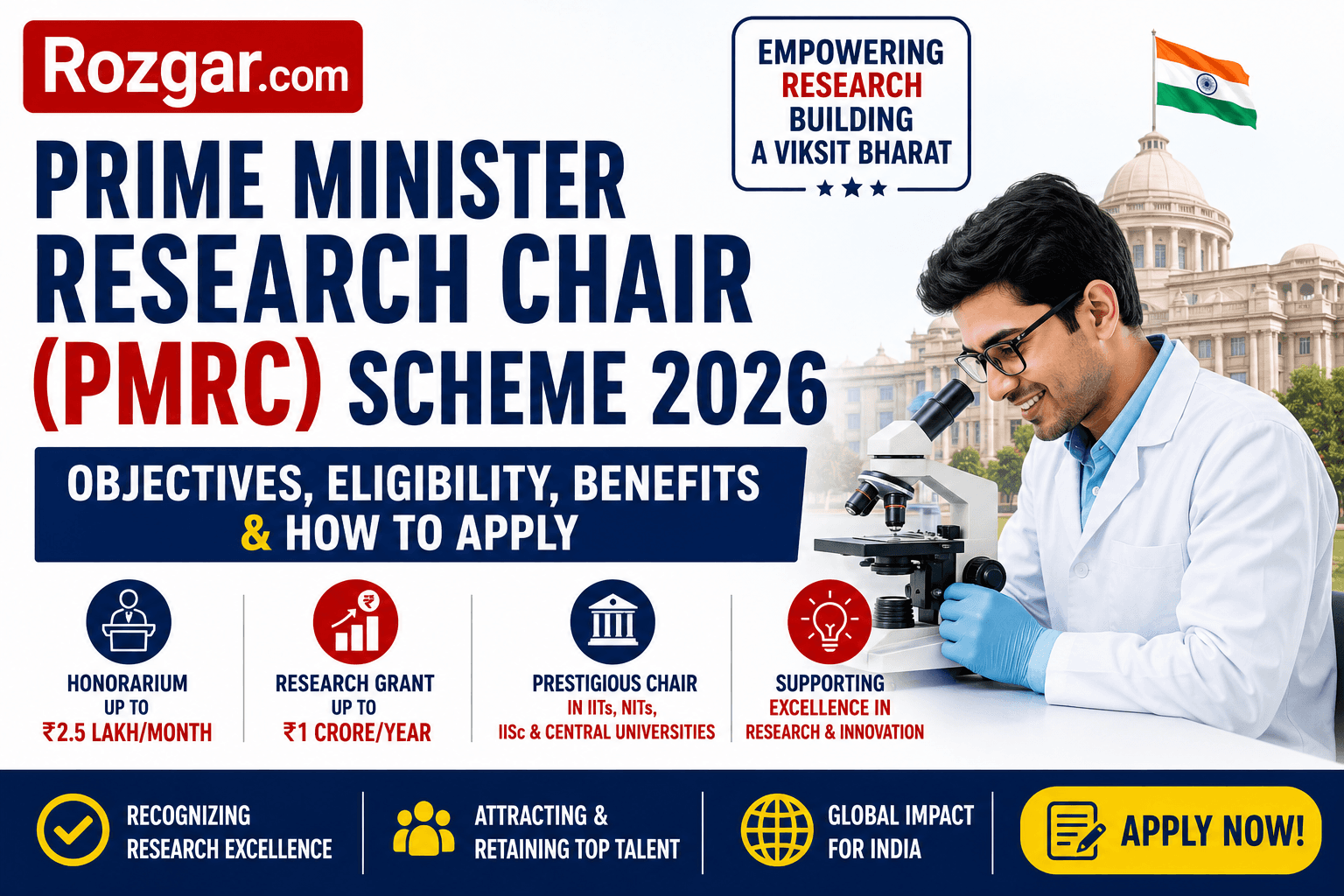
The government launched the Prime Minister Research Chair (PMRC) Scheme 2026 to honour senior researchers at IITs, NITs, IISc and central universities with ₹2.5 lakh per month honorarium and up to ₹1 crore annual research grant. Here is everything you need to know.
Prime Minister Research Chair (PMRC) Scheme 2026 – Objectives, Eligibility, Benefits and How to Apply
India has long been home to some of the worlds most brilliant scientific and academic minds. Yet for decades, many of the countrys most accomplished researchers have worked without the kind of financial recognition and institutional support that their counterparts in the United States, Europe, or China routinely receive. The government launched the Prime Minister Research Chair (PMRC) Scheme 2026 to change exactly that — and the response from the academic community has been overwhelmingly positive.
Whether you are a senior professor at an IIT, a scientist at IISc, or a faculty member at a central university wondering whether this scheme applies to you, this guide covers everything you need to know. We will walk you through what PMRC actually is, how it differs from PMRF, who qualifies, what financial benefits are on the table, how the selection process works, and how to apply — all in plain language without unnecessary jargon.
What Is the Prime Minister Research Chair (PMRC) Scheme 2026?
The Prime Minister Research Chair Scheme is a prestigious research recognition programme launched by Indias Ministry of Education. Its core purpose is to identify and honour senior faculty members and researchers who have spent their careers building Indias knowledge base — and give them the resources, recognition, and freedom to continue doing high-impact work at the very highest level.
Under this scheme, selected researchers are awarded a named "Chair" within their institution. This Chair comes with a substantial monthly honorarium, an annual research grant, and dedicated institutional support — all designed to allow the researcher to focus entirely on path-breaking work without administrative or financial distractions.
The PMRC Scheme is directly aligned with the goals of the National Education Policy (NEP) 2020, which envisions India becoming a global knowledge economy by 2040. By investing in its best minds at the peak of their careers, the government is making a clear statement: world-class research will be funded and celebrated in India, not just abroad.
How Is PMRC Different from PMRF?
This is one of the most commonly asked questions, and the distinction matters. ThePrime Ministers Research Fellows (PMRF)programme is designed for PhD students who are just beginning their research journey. It offers a monthly stipend of ₹70,000 to ₹80,000 to support doctoral work at premier institutions.
ThePrime Minister Research Chair (PMRC), on the other hand, is for established, senior researchers who have already made significant contributions to their field. Where PMRF is a launching pad, PMRC is a recognition of a career well-lived and a commitment to keep pushing the frontier. The two programmes complement each other — one nurtures new talent, the other rewards and sustains proven excellence.
Key Objectives of the PMRC Scheme 2026
The government designed PMRC with a set of very specific goals that go well beyond simply giving money to deserving professors.
Recognising Academic Excellence at the Highest Level
India produces an enormous volume of research every year, but not all of it gets the visibility or support it deserves. PMRC is built to change that by identifying researchers whose work has already demonstrated national and international impact, and giving them the backing to produce even more.
Stopping Brain Drain Before It Starts
One of the most persistent problems in Indian academia is the loss of top talent to foreign universities and research institutions. A Professor who might otherwise accept a chair at MIT or Oxford now has a genuinely competitive offer to stay in India, contribute to home-grown institutions, and mentor the next generation of Indian researchers.
Elevating Indias Global Research Rankings
QS World University Rankings, Times Higher Education Rankings, and the Nature Index all weigh research output and citation impact heavily. PMRC Chair Holders are expected to produce high-impact publications, build international collaborations, and attract global research funding — all of which directly improve the standing of Indian universities on the world stage.
Mentoring the Next Generation
A PMRC Chair is not just an individual honour. Chair Holders are expected to actively supervise PhD scholars, guide junior faculty, and help build a strong research culture within their institution. This multiplier effect is one of the most important — and often underappreciated — aspects of the scheme.
Financial Benefits — What Does a PMRC Chair Holder Actually Receive?
The PMRC Scheme 2026 is one of the most financially generous academic recognition programmes ever offered by the Indian government. Here is a detailed breakdown of what Chair Holders can expect.
Monthly Honorarium — ₹2.5 Lakh Over and Above Regular Salary
PMRC Chair Holders receive an additional honorarium of₹2.5 lakh per month, paid on top of their existing salary and allowances. This is not a replacement salary — it is a supplementary recognition amount. Over a 5-year term, this translates to an additional ₹1.5 crore purely as an honorarium.
Annual Research Grant — ₹50 Lakh to ₹1 Crore Per Year
Each Chair Holder is given an annual research grant ranging from₹50 lakh to ₹1 crore, depending on the nature of the research and the requirements of the project. This grant can be used for:
- Purchasing specialised research equipment and laboratory upgrades
- Hiring research assistants, postdocs, and project staff
- Travel for international conferences, collaborations, and field research
- Publication and open-access journal fees
- Setting up pilot projects or technology demonstrations
Duration of the Chair — 5 Years
The PMRC Chair is awarded for a period of5 years. In exceptional cases where the Chair Holders research output during the tenure has been outstanding, an extension may be considered by the Ministry.
Institutional Support
Beyond the financial benefits, PMRC Chair Holders are provided with:
- Dedicated research laboratory or office space within their institution
- Administrative and technical support staff
- Priority access to institutional computing and library resources
- Institutional branding support for international grant applications
Who Can Apply — PMRC Scheme 2026 Eligibility Criteria
The Prime Minister Research Chair is not a general fellowship — it is a selective honour with clearly defined eligibility requirements.
Institutional Eligibility
To be eligible, an applicant must be apermanent, regular faculty memberat one of the following:
- Indian Institutes of Technology (IITs)
- Indian Institute of Science (IISc), Bengaluru
- National Institutes of Technology (NITs)
- Indian Institutes of Science Education and Research (IISERs)
- Central Universities recognised by UGC
- Other Centrally Funded Technical Institutions (CFTIs)
Guest lecturers, adjunct professors, visiting faculty, and contractual staff arenot eligible. Private university faculty members are also currently outside the scope of this scheme.
Research Track Record
- Minimum10 to 15 yearsof research and teaching experience at a recognised institution
- A strong publication record inhigh-impact, internationally peer-reviewed journals(Scopus, Web of Science, or equivalent indexed)
- A credibleh-indexrelative to the applicants field and career stage
- Evidence ofsignificant research grantspreviously received and successfully executed
- Patents, technology transfer agreements, or documented industry-academia collaborations are considered a strong plus
Subject Areas Covered
The PMRC Scheme covers a broad range of disciplines:
- Science, Technology, Engineering, and Mathematics (STEM)
- Artificial Intelligence, Data Science, and Computational Research
- Health Sciences and Biomedical Research
- Social Sciences, Humanities, and Policy Studies
- Environmental Science and Climate Research
- Agriculture and Food Technology
Age Limit
Applicants should generally bebelow 60 years of ageat the time of application. In extraordinary cases, exceptions may be considered at the Ministrys discretion.
Selection Process — How Is a PMRC Chair Awarded?
The selection process for the Prime Minister Research Chair is rigorous, multi-layered, and transparent. It is designed to ensure that only researchers with a proven and verifiable track record are selected.
Stage 1 — Nomination or Direct Application
Institutions can nominate their top researchers, or eligible faculty can apply directly through the official portal. The application must include a detailed research proposal outlining the work planned during the Chair period.
Stage 2 — Initial Screening Committee
A screening committee constituted by the Ministry of Education reviews all applications. The committee assesses the quality and impact of publications, citation records, h-index, completed projects, and the relevance of the proposed research to national priorities.
Stage 3 — Expert Panel Review and Presentation
Shortlisted candidates are asked to present their research proposal before a high-level expert panel comprising eminent national and international scholars. This panel evaluates the scientific depth, feasibility, and potential impact of the proposed work.
Stage 4 — Final Selection and Notification
The Ministry of Education issues the final list of selected PMRC Chair Holders and sends formal appointment letters. The Chair is formally inaugurated at the respective institution.
PMRC and Indias Push for Global Research Rankings
The context around the PMRC Scheme 2026 matters as much as the scheme itself. India is currently working hard to place more of its institutions in the QS World University Top 100 and to increase its presence in the Nature Index — a measure of high-quality scientific output published in leading journals.
Research output and citation impact are among the heaviest weighted factors in all major global rankings. A single PMRC Chair Holder who publishes 15 to 20 high-impact papers over their five-year tenure can meaningfully improve an institutions citation scores and international visibility.
The government has set a target of establishing at least50 new PMRC Chairsacross various institutions in 2026 alone. Over the next decade, the cumulative effect of this investment is expected to significantly elevate Indias position in the global academic landscape.
How to Apply for PMRC Scheme 2026 — Step by Step
Documents Required
Before starting your application, gather the following:
- Updated academic CV with full publication list, citations, and h-index details from Google Scholar or Scopus
- Detailed 5-year research proposal (8 to 12 pages, including methodology, expected outcomes, and budget plan)
- Recommendation letter from the Head of Institution or Dean of Research
- List of top 10 publications from the last 10 years with PDF copies
- Details of completed and ongoing research projects with funding amounts
- Patent certificates, industry collaboration agreements, or technology transfer documents (if applicable)
- Declaration of permanent employment status at the institution
Where to Apply
PMRC notifications and application portals are published on:
- education.gov.in(Ministry of Education)
- ugc.ac.in(University Grants Commission)
- aicte-india.org(AICTE — for technical institution faculty)
Notifications are released periodically — typically annually or biennially. Bookmark these portals and subscribe to their official update channels to avoid missing a notification window.
Conclusion
The governments launch of the Prime Minister Research Chair (PMRC) Scheme 2026 is one of the most meaningful investments India has made in its academic ecosystem in recent memory. By offering senior researchers both financial recognition and the freedom to pursue high-impact work without distraction, the scheme addresses two of the biggest barriers to world-class research in India — inadequate funding and lack of institutional prestige.
Frequently Asked Questions
Create Your Free Job Alert
Related Posts
View All
Prime Minister Research Chai...
Prime Minister Research Chair (PMRC) Scheme 2026 – Objectives, Eligibility, Benefits and How to Apply
India has long been home to some of the worlds most brilliant scientific and academic minds. Yet for dec...
read more Ayush Yadav 08 Jul, 2026
आंध्र प्रदेश में 794 सरकारी ...
आंध्र प्रदेश में 794 सरकारी नौकरियां 2026 – विभिन्न विभागों में भर्ती का पूरा विवरण
अगर आप आंध्र प्रदेश में सरकारी नौकरी की तलाश में हैं, तो यह खबर आपके लिए किसी खजाने से कम नहीं। आंध्र प्रदेश सरकार ने 20...
read more Ayush Yadav 06 Jul, 2026
Viksit Bharat – Guarantee fo...
Viksit Bharat – Guarantee for Rozgar and Ajeevika Mission (Gramin): VB-G RAM G योजना की पूरी जानकारी
गांव में रहने वाले लाखों परिवारों के लिए रोजगार की गारंटी हमेशा से एक बड़ा मुद्दा रही है। पिछले करीब दो द...
read more Ayush Yadav 01 Jul, 2026